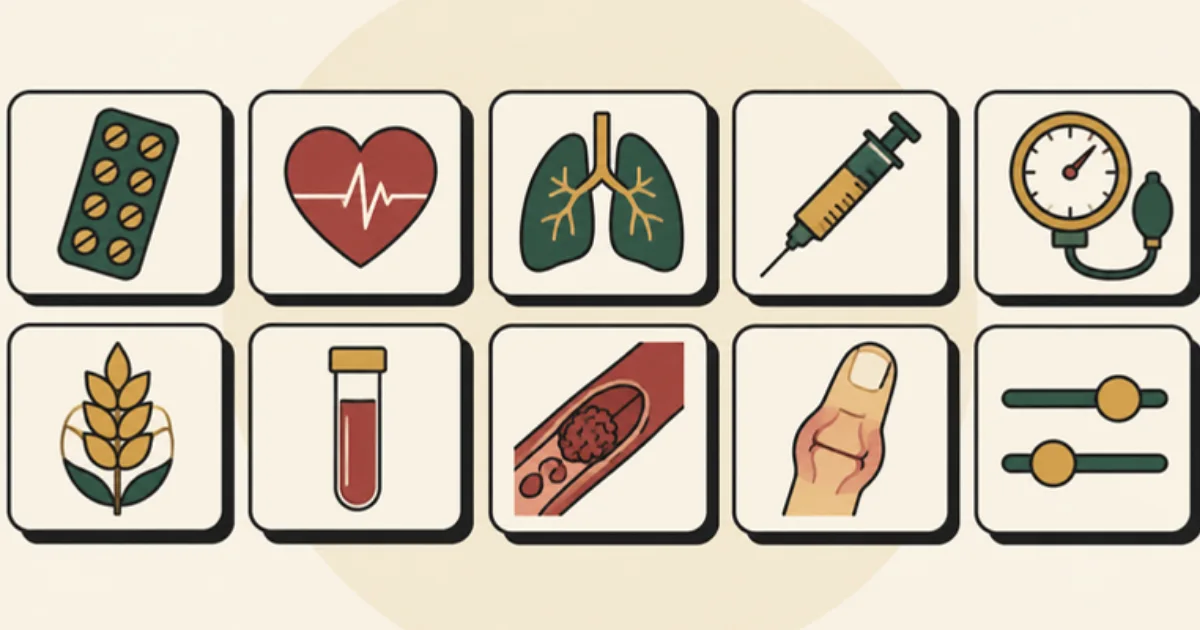
Single best answer questions are built from one clear rule and one tempting wrong answer. Each topic below gives you both. For how the CPST fits the wider process, see our ICGP CPST 2027 guide, and for the other half of exam day, our SJT guide.
How this page works
- Every topic has the same layout. A three-line brief (why it is tested, the rule, the trap), the facts grouped by what you do with them, then a quick check.
- Time. About 15 minutes to read the whole list. Take about three topics a week and answer questions on each.
- Sources. UK and Irish guidance, listed at the end. Guidance changes, so check current versions before you rely on a threshold or dose.
The ten rules at a glance
- Contraception: Ask about aura, BMI and blood pressure before choosing an oestrogen method.
- MI and ECG: Name the leads, then the artery. Aspirin 300 mg first.
- Croup: Steroid for every child. Severity and the response to treatment decide who goes home.
- Anaphylaxis: Intramuscular adrenaline first, into the mid-thigh. 500 micrograms for an adult.
- Hypertension: Confirm on ABPM, follow A, C, D in order, and check standing pressure before a fourth drug.
- Coeliac disease: Test tTG-IgA with total IgA while they are still eating gluten.
- AF scores: A CHA₂DS₂-VASc of 2 or more means offer a DOAC. Use the bleeding score to fix risk factors.
- STIs: Match the infection to its test and drug, and offer an HIV test every time.
- PE: Wells over 4 goes to CTPA. Wells 4 or below goes to D-dimer.
- Rheumatoid arthritis: Refer early on the clinical picture. Anti-CCP matters, deformity does not.
Contraception: Check UKMEC Before You Choose
- Why it’s tested
- Stems stack risk factors (PCOS, obesity, migraine) and ask whether a method is allowed.
- The rule
- Ask about aura, BMI and blood pressure before choosing an oestrogen method.
- The trap
- PCOS, obesity and migraine in one stem invite a quick answer. Go back for the two details that decide it: whether the migraine has aura, and the actual BMI.
Check eligibility
- UKMEC 4, do not use a combined method: migraine with aura, previous VTE, smoking 15 or more a day aged over 35, blood pressure of 160/100 or above, and breastfeeding under 6 weeks postpartum.
- Still allowed: starting a combined method with migraine without aura (UKMEC 2) or BMI 30–34 (UKMEC 2). BMI of 35 or more is UKMEC 3, and so is controlled hypertension.
Choose the method
- The implant, progestogen-only pill and intrauterine methods contain no oestrogen, so a history of VTE or migraine with aura does not rule them out.
- Heavy periods plus a wish for contraception: the levonorgestrel IUS (Mirena) is the first-line choice, and it also thins the endometrium.
Emergency contraception
- Emergency contraception: offer the copper IUD first, up to 5 days after unprotected sex or up to 5 days after the earliest estimated ovulation. Ulipristal 30 mg works up to 120 hours. Levonorgestrel 1.5 mg is licensed up to 72 hours. If BMI is over 26 or weight over 70 kg and a copper IUD is not suitable, FSRH advises ulipristal, and suggests considering levonorgestrel 3 mg only if ulipristal is not suitable.
When something goes wrong
- Pelvic pain with an IUS in place: do a pregnancy test first. Absolute ectopic risk is lower than with no contraception, but a higher share of the pregnancies that do occur are ectopic.
Quick check A 28-year-old with PCOS, BMI 31 and migraine without aura asks for contraception. Is the combined pill allowed?
Answer: Yes. Migraine without aura and BMI 30–34 are both UKMEC 2. If the migraine had aura, the combined pill would be UKMEC 4 and an implant or IUS would be the answer.
Myocardial Infarction: Name the Artery From the ECG
- Why it’s tested
- ECG territory and the first-line drugs in ACS are asked directly.
- The rule
- Name the leads, then the artery. Aspirin 300 mg first.
- The trap
- ST depression in V1–V3 looks like anterior ischaemia. Tall R waves in the same leads mean posterior infarction, so ask for V7–V9.
Read the ECG
| ECG leads with ST change | Territory | Usual artery |
|---|---|---|
| II, III, aVF | Inferior | Right coronary |
| V1–V4 | Anteroseptal | Left anterior descending |
| V1–V6, I, aVL | Anterolateral | Proximal left anterior descending |
| I, aVL ± V5–V6 | Lateral | Left circumflex |
| ST depression and tall R waves in V1–V3 (confirm with V7–V9) | Posterior | Usually left circumflex, sometimes right coronary |
- STEMI is diagnosed on the ECG and history. Do not wait for troponin, which can be normal early.
- Inferior MI: think right ventricular involvement. Avoid nitrates if the patient is hypotensive.
- New LBBB does not diagnose STEMI by itself. It should raise concern if the symptoms are ongoing.
Treat
- First drug in suspected ACS: aspirin 300 mg. Oxygen only if saturations are below 94% and the patient is not at risk of hypercapnic failure. Treat pain with GTN, and add an IV opioid such as morphine if an MI is suspected. The old MONA mnemonic is out of date on oxygen.
- Reperfusion: primary PCI if the patient presents within 12 hours and PCI can be delivered within 120 minutes of when fibrinolysis could have been given. If not, fibrinolysis.
Quick check ST elevation in II, III and aVF: which artery is usually responsible, and which drug do you give straight away?
Answer: Right coronary artery. Aspirin 300 mg.
Croup: Steroids for Every Child, Hospital for Moderate or Severe
- Why it’s tested
- A common paediatric emergency where the home-or-hospital decision is easy to get wrong.
- The rule
- Steroid for every child. Severity and the response to treatment decide who goes home.
- The trap
- Mild croup still gets dexamethasone. A child who is eating, drinking and playing can go home, but still needs the steroid.
Recognise it
- Who: mostly 6 months to 3 years, usually parainfluenza, with a barking seal-like cough that is worse at night, stridor and coryza. More cases in autumn.
- Do not examine the throat in a child with stridor. It can precipitate complete obstruction.
- A chest X-ray is rarely needed. A steeple sign on a PA film points to croup, and a thumb sign on a lateral film points to epiglottitis. It is viral, so antibiotics do not help.
Treat
- Give a steroid to every child. Oral dexamethasone 0.15 mg/kg once is the usual dose (NICE CKS), and it is effective in mild croup. The Irish paediatric guideline from Children’s Health Ireland at Crumlin (OLCHC) also notes 0.6 mg/kg has been used, with some evidence of benefit in severe disease, and accepts IM dexamethasone or nebulised budesonide if the child vomits the oral dose. Prednisolone is the alternative if dexamethasone is not available.
- Severe croup (marked recession, agitation or lethargy): high-flow oxygen and nebulised adrenaline. A child who has had nebulised adrenaline needs observation for at least 4 hours.
Home or hospital
- Grade by stridor at rest, recession and distress. A child who is eating, drinking and playing after the steroid can usually go home. Moderate or severe croup needs hospital assessment, and the decision to admit is made after treatment and a period of observation.
- Stridor at rest must settle before discharge. Stridor only on exertion in an otherwise well child can be considered for discharge.
- Consider admission even for mild croup in a child with Down syndrome or known upper-airway narrowing such as subglottic stenosis.
Quick check An 18-month-old has a barking cough, audible stridor at rest and mild recession, but is still drinking. What treatment, and where?
Answer: That is moderate croup: give dexamethasone 0.15 mg/kg orally and arrange hospital assessment. Discharge is decided after treatment and observation, and only once the stridor at rest has settled.
Anaphylaxis: Adrenaline First, Dose by Age
- Why it’s tested
- Dose by age is a recall question, and the order of drugs is the trap.
- The rule
- Intramuscular adrenaline first, into the mid-thigh. 500 micrograms for an adult.
- The trap
- The tempting first move is chlorphenamine or a steroid because they feel safe. Neither is first-line. In primary care adrenaline is given intramuscularly, never intravenously.
Recognise it
- Diagnosis needs an airway, breathing or circulation problem after a trigger, usually with skin changes. Urticaria alone is not anaphylaxis.
Treat
| Age | IM adrenaline 1 in 1,000 |
|---|---|
| Under 6 months | 100–150 micrograms |
| 6 months to 6 years | 150 micrograms |
| 6 to 12 years | 300 micrograms |
| Over 12 years and adults | 500 micrograms |
- Inject into the anterolateral mid-thigh. Repeat every 5 minutes if there is no adequate response.
- Position: flat, with or without legs raised. Sit the patient up only if breathing is the main problem. Add high-flow oxygen, and IV fluids for shock.
- Antihistamines are third-line and come after stabilisation, and the 2021 Resuscitation Council UK guidance no longer advises routine corticosteroids. Neither replaces or delays adrenaline.
After the reaction
- Observation: fast-track discharge after 2 hours only if one dose gave a good response with complete resolution, the patient has trained access to adrenaline auto-injectors, and supervision is adequate. Otherwise at least 6 hours after two doses or a previous biphasic reaction, and at least 12 hours for more than two doses, severe asthma or a late-night presentation.
- Afterwards: serum tryptase if the diagnosis is unclear, referral to an allergy clinic, and two adrenaline auto-injectors with training.
Quick check A 9-year-old collapses after a wasp sting, with wheeze and hypotension. First drug, dose, route and site?
Answer: Adrenaline 300 micrograms (0.3 mL of 1 in 1,000) intramuscularly, into the anterolateral thigh.
Want to practise as you read?
Join GP Journey to get 250 highly curated, high-yield CPST questions on topics like these, each with a full explanation.
Hypertension and Postural Hypotension
- Why it’s tested
- Stepwise drug choice, thresholds and a postural-pressure check.
- The rule
- Confirm on ABPM, follow A, C, D in order, and check standing pressure before a fourth drug.
- The trap
- A patient with type 2 diabetes starts on an ACE inhibitor or ARB at any age. A beta-blocker is not an early add-on: it only appears at step 4, when potassium is above 4.5.
Confirm and stage
- Confirm with ABPM (or home readings) after a clinic reading of 140/90 or more. Stage 1 is ABPM 135/85 or more. Stage 2 is 150/95 or more.
- Stage 1: discuss treatment if under 80 with target organ damage, cardiovascular or renal disease, diabetes, or 10-year risk of 10% or more. Stage 2: offer treatment at any age.
- Targets: clinic below 140/90 under 80 years, and below 150/90 from 80.
Treat step by step
- Step 1: ACE inhibitor or ARB if type 2 diabetes at any age, or if under 55 and not of Black African or African-Caribbean origin. Calcium channel blocker if 55 or over, or of Black African or African-Caribbean origin, without type 2 diabetes.
- Step 2: add a calcium channel blocker or a thiazide-like diuretic to the ACE inhibitor or ARB. Step 3: A + C + D, using indapamide as the diuretic. Step 4: confirm on ABPM, check for postural drop and adherence, then consider spironolactone if potassium is 4.5 or below, or an alpha- or beta-blocker if it is above 4.5.
Postural hypotension
- Postural hypotension: measure lying (or seated), then again after standing for at least 1 minute. A fall of 20 mmHg systolic or 10 mmHg diastolic is positive.
- Then review the drugs. Diuretics, vasodilators and alpha-blockers are the usual culprits. Statins and metformin rarely are.
Quick check A patient on perindopril and amlodipine has an ABPM average of 152/94. What is the next drug?
Answer: Indapamide. That completes step 3: A + C + D.
Coeliac Disease: Test While They Are Eating Gluten
- Why it’s tested
- Most wrong answers come from the timing of the test and the order of events.
- The rule
- Test tTG-IgA with total IgA while they are still eating gluten.
- The trap
- Do not start a gluten-free diet “to see if it helps” before the blood test and biopsy. It can make a true positive look normal.
Who to test
- Who to test (NICE): persistent unexplained abdominal or GI symptoms, unexplained iron, B12 or folate deficiency, weight loss, prolonged fatigue, severe or persistent mouth ulcers, IBS in adults, type 1 diabetes and autoimmune thyroid disease at diagnosis, and first-degree relatives.
How to test
- First-line test: tissue transglutaminase IgA. Measure total IgA at the same time. In IgA deficiency use an IgG-based test instead.
- The patient must be eating gluten in more than one meal a day for at least 6 weeks before testing. A gluten-free diet started early gives a false negative, and NICE advises waiting for the specialist diagnosis before starting one.
- In adults, serology suggests it and a duodenal biopsy confirms it. Adults with positive serology are referred to gastroenterology for biopsy. Children go to paediatric gastroenterology, and the HSE paediatric coeliac algorithm follows ESPGHAN 2020, which allows diagnosis without biopsy in selected children.
Associations and complications
- Anaemia: iron deficiency is the usual pattern, and folate deficiency is more common than B12.
- Complications: osteoporosis, enteropathy-associated T-cell lymphoma, subfertility, and hyposplenism, which is why patients are offered pneumococcal vaccine.
Quick check A 34-year-old has iron-deficiency anaemia and no other symptoms. What is the first test for coeliac disease?
Answer: Tissue transglutaminase IgA, with total IgA, while they are still eating gluten.
CHA₂DS₂-VASc and HAS-BLED in Atrial Fibrillation
- Why it’s tested
- Two scores do two different jobs, and several versions are in circulation.
- The rule
- A CHA₂DS₂-VASc of 2 or more means offer a DOAC. Use the bleeding score to fix risk factors.
- The trap
- A previous bleed does not automatically mean no anticoagulant. NICE prefers a DOAC to warfarin, and treats a high bleeding score as a prompt to correct what can be corrected.
Score the stroke risk
| CHA₂DS₂-VASc factor | Points |
|---|---|
| Congestive heart failure | 1 |
| Hypertension | 1 |
| Age 75 or over | 2 |
| Diabetes | 1 |
| Stroke, TIA or thromboembolism | 2 |
| Vascular disease | 1 |
| Age 65–74 | 1 |
| Female sex | 1 |
- Score 2 or more: offer anticoagulation. A man with 1: consider it. A woman whose only point is her sex: no treatment.
Choose the drug
- A DOAC is first-line (apixaban, dabigatran, edoxaban or rivaroxaban). Warfarin is second-line. Aspirin is not recommended for stroke prevention in AF.
- Apixaban 2.5 mg twice daily if two of these apply: age 80 or over, weight 60 kg or less, creatinine 133 µmol/L or more.
Bleeding risk
- HAS-BLED counts hypertension (systolic over 160), abnormal renal or liver function, stroke, bleeding history, labile INR, age over 65, and drugs or alcohol. A score of 3 or more means high bleeding risk.
- Use the bleeding score to fix risk factors, not to withhold treatment. NICE lists uncontrolled hypertension, poor INR control, antiplatelets, SSRIs and NSAIDs, harmful alcohol use and reversible anaemia.
- HAS-BLED is the bleeding score used in Irish practice. Other sources differ: NICE recommends ORBIT instead, and the 2024 ESC guideline drops the sex point from the stroke score (CHA₂DS₂-VA). If a question names a different score, use the one it names.
Quick check A 72-year-old woman with hypertension and diabetes has new AF. What is her CHA₂DS₂-VASc score, and what do you do?
Answer: Hypertension 1, diabetes 1, age 65–74 1, female sex 1: a score of 4. Offer a DOAC such as apixaban.
STIs: Know the Test, the Drug and the Stage
- Why it’s tested
- Each infection has its own sample, first-line drug and staging fact.
- The rule
- Match the infection to its test and drug, and offer an HIV test every time.
- The trap
- A positive treponemal test in someone treated years ago does not mean new infection. Use the RPR or VDRL titre and the clinical picture.
Chlamydia and gonorrhoea
- Chlamydia: NAAT on a vulvovaginal swab in women or first-void urine in men. Test at presentation, and repeat 2 weeks after exposure if the exposure was within the last 2 weeks. Doxycycline 100 mg twice daily for 7 days is first-line (BASHH 2026). Azithromycin is used in pregnancy, and where doxycycline is not suitable.
- Gonorrhoea: NAAT plus culture before treatment, because culture gives sensitivities. Sample every exposed site. First-line treatment is ceftriaxone 1 g intramuscularly. Disseminated infection (tenosynovitis, migratory polyarthritis, dermatitis) is the commonest cause of septic arthritis in young adults.
Syphilis
- Primary syphilis: typically a single painless chancre. It can be anal, and in women it may sit on the cervix and go unseen.
- Secondary syphilis, about 3–10 weeks after the chancre appears: a widespread rash including the palms and soles, generalised lymphadenopathy, mucosal ulcers and condylomata lata.
- Syphilis serology: treponemal tests (TPPA or EIA) stay positive for life, so they cannot show current activity. RPR or VDRL titres track treatment, and a fourfold fall is an adequate response. Early syphilis is treated with a single intramuscular dose of benzathine penicillin. Neurosyphilis needs procaine penicillin with probenecid, or IV benzylpenicillin, because benzathine penicillin does not reliably reach the CSF.
- Syphilis is a notifiable disease in Ireland, and the HSE guideline asks for referral to a sexual health or GUM service.
HIV testing
- Offer an HIV test with every STI screen. Use a fourth-generation (combined antigen/antibody) test. Irish (HPSC) and UK guidance both give it a 45-day window period, so a negative result is only conclusive 45 days after exposure.
Quick check A man who has sex with men has a painless anal lump and a rash on his palms and soles. Diagnosis and first-line treatment?
Answer: Secondary syphilis, treated with intramuscular benzathine penicillin.
Pulmonary Embolism: Wells Score, Then the Right Test
- Why it’s tested
- Wells-then-D-dimer is a standard two-step question.
- The rule
- Wells over 4 goes to CTPA. Wells 4 or below goes to D-dimer.
- The trap
- Haemoptysis after a long journey is PE. Read “haematemesis” twice before you let it send you to the GI chapter.
Score the probability
| Wells feature | Points |
|---|---|
| Clinical signs of DVT | 3 |
| An alternative diagnosis is less likely than PE | 3 |
| Heart rate over 100 | 1.5 |
| Immobilised over 3 days or surgery in the last 4 weeks | 1.5 |
| Previous DVT or PE | 1.5 |
| Haemoptysis | 1 |
| Malignancy | 1 |
- Wells over 4 (PE likely): straight to CTPA, and start anticoagulation without delay while you wait.
- Wells 4 or below (PE unlikely): D-dimer first. Negative excludes PE. Positive goes to CTPA.
Test
- D-dimer rules out and does not rule in. Consider an age-adjusted threshold over 50 (age × 10 micrograms/L FEU). Do not use it when probability is high.
- CTPA is the usual first imaging. Use a V/Q scan for contrast allergy, severe renal impairment (creatinine clearance under 30 mL/min) or a high radiation risk.
- ECG: sinus tachycardia is the commonest finding. S1Q3T3 is famous but is seen in fewer than 1 in 5 cases. Right bundle branch block and right axis deviation also occur. A chest X-ray is usually normal.
Treat
- Treatment: apixaban or rivaroxaban is first-line. The HSE National Clinical Guideline on VTE (2025) recommends LMWH or a DOAC for most patients with intermediate or low-risk PE, for at least 3 months. Triple-positive antiphospholipid syndrome needs LMWH with warfarin, established renal failure needs LMWH, and pregnancy needs LMWH.
Quick check A patient has a heart rate of 105 and pleuritic chest pain 10 days after laparoscopic cholecystectomy. You think another diagnosis is more likely. First test?
Answer: Heart rate over 100 (1.5) plus recent surgery (1.5) is 3, so PE is unlikely. Do a D-dimer.
Rheumatoid Arthritis: Early Referral and the Right Antibody
- Why it’s tested
- Early recognition and referral are tested more than drug detail.
- The rule
- Refer early on the clinical picture. Anti-CCP matters, deformity does not.
- The trap
- A negative rheumatoid factor does not exclude RA. A normal ESR does not either. Ask for anti-CCP, and refer on the clinical picture.
Recognise it
- Pattern: symmetrical swelling of the small joints of the hands and feet, morning stiffness, and a positive squeeze test across the MCP or MTP joints.
- Ulnar deviation, swan-neck and boutonnière deformities are late features. Their absence does not argue against early disease.
Investigate
- Anti-CCP is the most specific blood test, at 90–95%. Rheumatoid factor is positive in 70–80% of RA but also in about 5% of the general population. NICE advises anti-CCP when RF is negative.
- Also request ESR or CRP, and X-rays of the hands and feet.
Refer and treat
- Refer for suspected persistent synovitis of unknown cause, urgently if the small joints of the hands or feet are affected, more than one joint is involved, or symptoms have lasted 3 months or more. Normal inflammatory markers or negative serology do not change this.
- In Ireland suspected inflammatory arthritis goes through the national early inflammatory arthritis referral form, and the rheumatology centres taking part aim to see patients within 6 weeks of referral.
- Start a DMARD early, ideally within 3 months of symptom onset. Oral methotrexate, leflunomide or sulfasalazine are the first-line options, sometimes with a short bridging course of steroid. Methotrexate is taken once weekly and needs FBC and LFT monitoring.
Do not miss
- One hot, swollen joint in a patient with RA is septic arthritis until proven otherwise. Aspirate it before antibiotics.
Quick check A patient with RA has one hot, swollen knee and cannot move it. Everything else is quiet. What is the next test?
Answer: Joint aspiration, for Gram stain and culture, because septic arthritis must be excluded.
How to Work Through This List
Work through the topics in order, about three a week. After each one, answer 10 to 15 questions on it the same day and read every explanation, including the ones you got right. A right answer reached for the wrong reason will not hold up under time pressure. Finish with at least one full 50-question paper in 60 minutes. The CPST preparation guide covers pacing and what to do in the final week.
Guidance behind this list: NICE NG136 Hypertension in adults; NICE NG196 Atrial fibrillation; NICE NG158 Venous thromboembolic diseases; NICE NG185 Acute coronary syndromes; NICE CG95 Chest pain of recent onset; NICE NG20 Coeliac disease; NICE NG100 Rheumatoid arthritis in adults; NICE NG88 Heavy menstrual bleeding; NICE CKS Croup; UK Medical Eligibility Criteria for Contraceptive Use (UKMEC 2025); FSRH Emergency Contraception guideline; Resuscitation Council UK, Emergency treatment of anaphylaxis (2021); BASHH chlamydia (2026), gonorrhoea (2025) and syphilis (2024) guidelines; HSE Syphilis guideline; HSE Approach to an STI consultation in primary care; HPSC post-exposure prophylaxis guidelines; OLCHC croup guideline; HSE paediatric coeliac algorithm; HSE National Clinical Guideline on VTE (Eve’s Protocol, 2025); BHIVA/BASHH/BIA HIV testing guidelines (2020). Guidance changes. Check current versions before you rely on a threshold or dose.
Frequently asked questions
No. The ICGP publishes the format and the standard, not a blueprint. The CPST is 50 single best answer questions in 60 minutes, set at the standard of a current intern. This list is GP Journey’s own selection of common intern-level presentations, not an official syllabus.
The CPST is worth 10% of your overall ranking, alongside the SJT at 40% and the SBCA at 50%. You must also clear the pass mark, set by the Ebel method, before the 10% counts. Failing it means you are not shortlisted whatever your SJT score.
Take about three topics a week. Answer 10 to 15 questions on each topic the same day, then read every explanation, including those you got right. Finish with at least one full 50-question paper under timed conditions.
Ready to practise these ten topics?
Join GP Journey to practise 250 highly curated, high-yield CPST questions, each with a full explanation for every option. It’s free to join, and HSE TSS eligible for most candidates.